
The (very simple) Truth about Immigration
Intro:
The First World War is over. Victorious and defeated nations begin to recover, looking hopefully toward a better future. Some sooner, some later. The Roaring Twenties begin, a new phase of prosperity. Just as quickly as it arrived, it disappeared again with Black Friday in October 1929. A new crisis. New anxiety, unemployment, poverty, anger, shock, and fear.
A new defeat, felt everywhere. Especially in the German Reich, the losing nation of the First World War. Economic collapse, hyperinflation, political instability, and the loss of collective orientation created a climate of permanent overwhelm. In such phases, societies do not search for causes and solutions, but for culprits. The Jewish population became the projection surface for this crisis. Antisemitism was not a new phenomenon, but it reached new dimensions. Complex structural problems such as war consequences, the Treaty of Versailles, national debt and fears of social decline were reduced to a single group in order to regain a sense of control, at least emotionally. This mechanism is central to understanding debates that appear timeless: when societies come under pressure, analysis disappears and is replaced by simplification and exclusion. The word “exclusion” is, in this context, a dramatic understatement. Persecution did not arise from strength or superiority, but from weakness and disorientation.
The current political climate is a legitimate reason for fear. Fear that society may repeat this mistake. Much suggests that our own version of the Roaring Twenties could also experience a significant setback. Only our version actually began with the economic miracle of the 1950s and has therefore lasted for 75 years. A very long time, surely long enough to forget. Of course, our society today is less fragile than it was in the aftermath of the First World War. But that is not the decisive question. Is our society today strong and united enough to withstand the possible Black Friday of our century?
It is very likely a mistake to regard the state of recent decades as the new normal. What we are experiencing today in large parts of Western societies is, historically speaking, the exception rather than the rule. Migration is not a new phenomenon, nor a byproduct of a globalized world. Nor is it a failure of modern politics. Migration is the normal state of human civilization, perhaps even of all living species that have ever existed on this planet. Societies have grown, flourished, and become powerful because people migrated, not despite it.
Europe, North America, Australia: the economic and social rise of these regions would have been unthinkable without massive immigration. Industrialization meant demand for labor, and post-war orders meant reconstruction. Guest worker programs, waves of immigration, and internal migration were not primarily morally motivated, but economically necessary. States did not allow migration because they were altruistic, but because it was necessary for their own prosperity.
This historical perspective is more crucial today than ever, yet it has almost completely disappeared from public discourse. Migration is treated as an external shock from which we must protect ourselves because multiple crises have supposedly exhausted our capacity to deal with it. In reality, migration is structurally embedded in the functioning of modern economies. Migration has always been part of the solution, today more than ever.
We find ourselves at a point where several developments collide simultaneously. Demographic change is not a forecast, but a reality. The baby-boomer generations are leaving the labor market, while the following generations are smaller and more fragmented. A side effect of rising prosperity is declining birth rates. This is a historically proven fact. While this makes the development logically explainable, it does not reduce the danger that comes with it. Migration is the instrument through which this development can be counteracted, as shown by statistics from the Bertelsmann Foundation.
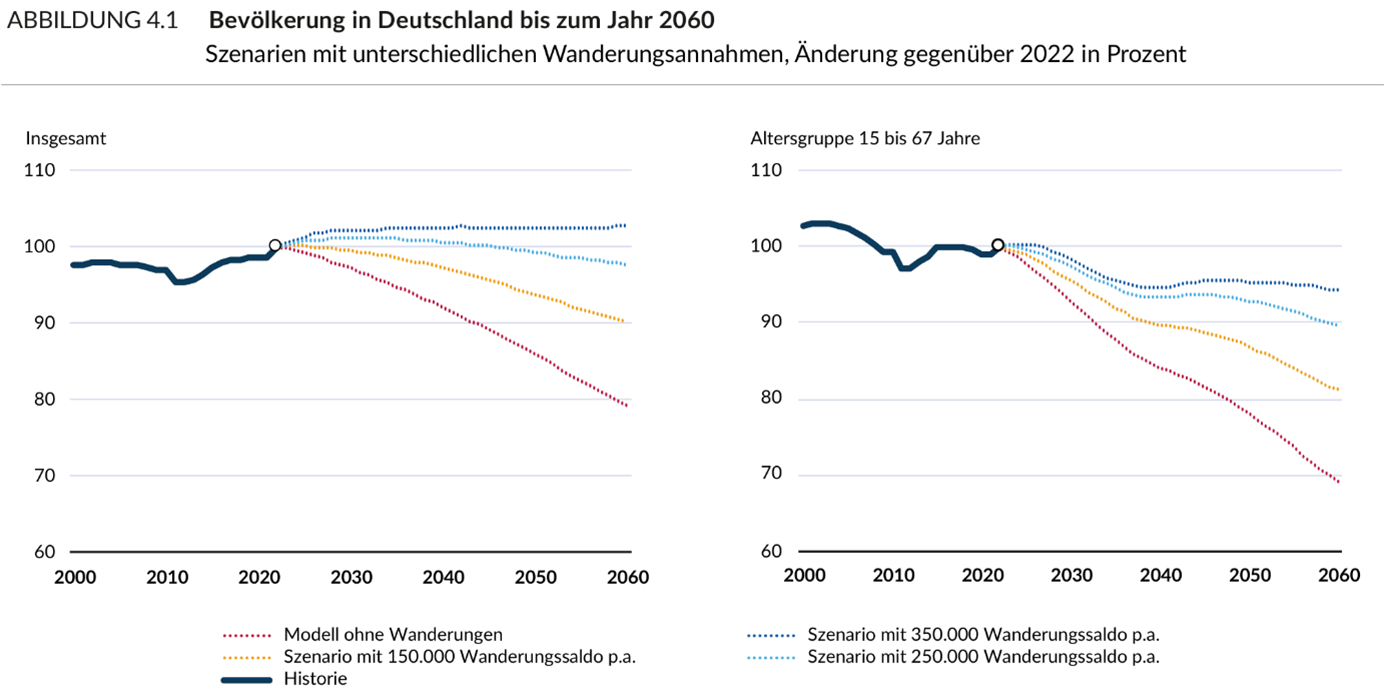
Bertelsmann Stiftung – Zuwanderung und Arbeitsmarkt
Labor shortages are a daily reality. A challenge for the economy and therefore for the state. Felt in industry, skilled trades, healthcare, gastronomy, logistics, and increasingly in knowledge-intensive professions.
At the same time, pension systems are under massive pressure. Pay-as-you-go systems function only if there are enough contributors. These contributors are missing. Productivity gains and automation can compensate for part of the gap, but by no means close it. Without additional people of working age, this equation is simply unsolvable.
And yet, it is precisely at this moment that we are witnessing a societal and political shift to the right. Migration becomes the projection surface for economic loss of control, structural overload, and cultural insecurity. Zeke Hernandez exposes this contradiction clearly in his book The Truth About Immigration. Not by appealing to moral conscience, but by separating data, structures, and misconceptions. He shows that many of today’s fears are genuinely felt but wrongly addressed. Problems exist, and the fears associated with them are logical and understandable. But they do not arise from the existence of migration itself; they arise from poorly managed processes, political short-sightedness, fragile integration systems, and, above all, from a discourse that prefers simplification and distortion over explanation.
[When it rains in summer after weeks of heat, we do not see the rain as a bad thing. We understand it as a necessity in a broader context: it affects harvests, food prices, water levels, energy supply, transportation, health, and much more. This helps society deal with the rain. It helps to contextualize emotions, even if the rain arrives on a day when sunshine would have been preferable.]
When it comes to migration, society behaves differently. Migration is viewed in isolation, detached from housing policy, education systems, economic strength and purchasing power, regional inequality, and state capacity. This creates the impression that migration is the cause of all these tensions. In reality, migration is only one of many building blocks. Just as rain is one component of the climate, migration is a component of a functioning state. With rain, society seems to understand and appreciate the function and enormous benefits of this component; with migration, it struggles. Yet unlike rain, migration can actually be influenced and controlled by the state. At present, migration serves merely as a scapegoat. A false explanation for structural challenges. This solves fewer problems than it creates: it blocks opportunities, divides society, and renders the state incapable of acting in the long term. Properly used, migration serves long-term state stability in a way no other component can.
The decisive question is not whether we need migration. That question has long been answered. We need it and we need a lot of it. The only question is how we design it.
Successful migration is complex and multifaceted. It requires selection, governance, clear expectations, and functioning institutions. It requires fast procedures, legal certainty, and consistent implementation. Integration is an infrastructural task. Language, work, housing, and education determine whether migration becomes a burden or a driver of growth. It is also true that poorly managed migration can become a burden. Conversely, when well managed, it can be an unparalleled opportunity. One thing is certain: the absence of migration always leads to strain and is never an opportunity.
A recurring pattern in major societal debates is the deliberate distortion of facts. Numbers are taken out of context, correlations are presented as causation, and isolated cases are generalized. Doubt is sown everywhere: about data, models, and the motives of science. These doubts are not created to reach better solutions, but to generate paralysis. The goal is not truth and progress, but delay. Those who constantly sow doubt ultimately achieve the exact opposite of their stated goals: economic weakening, social instability, and loss of competitiveness. While the rhetoric targets chaos and loss of control, it is precisely the measures that would ensure order, governance, and long-term stability that are blocked.
Emotionally charged topics therefore require clear communication and political honesty. Migration is not a cure-all. It does not automatically solve productivity problems, nor does it compensate for every past policy failure. But without migration, Western societies will age, shrink, and lose economic and political relevance. This is not a value judgment, but a sober assessment backed by evidence. Great powers maintain their position not despite population size, but because of it. The United States has long benefited from continuous immigration that fuels labor markets, innovation, and military and economic power. China derives scale effects, internal markets, and geopolitical weight from its demographic mass. Population is power and shrinking societies lose influence in every respect. Migration is therefore not merely domestic social or labor policy, but a geopolitical power factor.
What happens next depends on whether we are willing to accept this reality and whether politics can find the courage to prioritize long-term necessities over short-term sentiment. What should happen is clear: treat migration as a strategic instrument, not an exception. Improve processes, not stigmatize people.
Attempts to stop migration have always failed historically. Conversely, well-designed migration, implemented purposefully, has always resulted in prosperity, stability, and renewal. The question is not whether we want to take this path, but whether we can afford not to. Migration is not a switch that can be flipped; it is a process that takes time. Integration is not linear. It is contradictory, regionally diverse, and prone to friction. Our current system clearly does not function smoothly. Procedures are slow, responsibilities unclear, municipalities overburdened, and expectations poorly defined. These real weaknesses are deliberately exploited by certain political actors to delegitimize the entire process. Management failure is reframed as system failure. This is not only wrong, but dangerous to national interests. Ironically, the very interests those actors claim to defend. A flawed process is not an argument against necessity; it is an argument for improvement, not abolition.
Ultimately, migration can be viewed from two perspectives. One is moral: helping people in need, offering protection and opportunity. The other is sober: securing prosperity, stabilizing systems, and safeguarding the future of the state. Interestingly, both lead to the same conclusion. Even under the purely hypothetical assumption that we lived in a society of selfish, morally indifferent people, the conclusion would be identical. Everyone has an interest in prosperity, functioning pension systems, growth, labor supply, and stability. Migration is not an act of generosity. It is neither charity nor a moral favor granted out of goodwill. Migration is a necessity. It sustains prosperity, stabilizes structures, and ensures continuity in aging societies. That is why everyone needs it: idealists and cynics, altruists and egoists, socially minded and socially indifferent alike. Not because they want to be good, but because they want a secure and prosperous future for themselves.
States currently behave as if they are competing over who can accept the fewest migrants. In reality, they should recognize that they are competing over who can attract the most and the best-qualified migrants.
Sources
Zeke Hernandez – The Truth About Immigration
Bertelsmann Stiftung – Zuwanderung und Arbeitsmarkt, https://www.bertelsmann-stiftung.de/de/publikationen/publikation/did/zuwanderung-und-arbeitsmarkt
OECD – International Migration Outlook – https://www.oecd.org/migration/international-migration-outlook/
United Nations (UN DESA) – World Population Prospects – https://population.un.org/wpp/
European Commission – Ageing Report – https://economy-finance.ec.europa.eu/economic-and-fiscal-governance/ageing-report_en
World Bank – Migration and Development – https://www.worldbank.org/en/topic/migrationremittancesdiasporaissues
IMF – World Economic Outlook – https://www.imf.org/en/Publications/WEO
Eurostat – Migration and Migrant Population Statistics – https://ec.europa.eu/eurostat/statistics-explained/index.php?title=Migration_and_migrant_population_statistics
Ray Dalio – Principles for Dealing with the Changing World Order – https://www.principles.com/the-changing-world-order/